
How to Actually Read Your Credit Report (Most People Never Do)
Here is the uncomfortable truth. Most people pull their credit report, look at one number, feel their stomach drop, and close the tab. That is not reading your report. That is panicking at your report.
And here is the thing nobody tells you: the number you are panicking about probably is not even on the report. Your credit report and your credit score are two different things. The report is the raw file. The score is a grade calculated from that file. So if your goal is fixing your credit, the report is where the actual work happens. The score just tells you how the work is going.
If your credit is damaged, learning to read this document is the single most useful skill you can build. So let me walk you through it like I would over coffee.

First, get the real thing (for free)
Before you read anything, you need the actual report, and you need to get it from the right place. You can pull your report from all three major bureaus, Equifax, Experian, and TransUnion, completely free, every single week at AnnualCreditReport.com. The free weekly access started during the pandemic in 2020 and became permanent in September 2023. That site is the only one explicitly authorized by federal law to provide them.
Notice I said all three. You do not have one credit report. You have three, and they often do not match, because not every lender reports to every bureau. An error can sit on your TransUnion file and be totally absent from Equifax. So pull all three.
Ignore the copycat sites with "free" in the name that ask for a credit card. The real one never does. And a small bonus: everyone in the US can grab six additional free Equifax reports per year through 2026 at that same site.

The four parts of every report
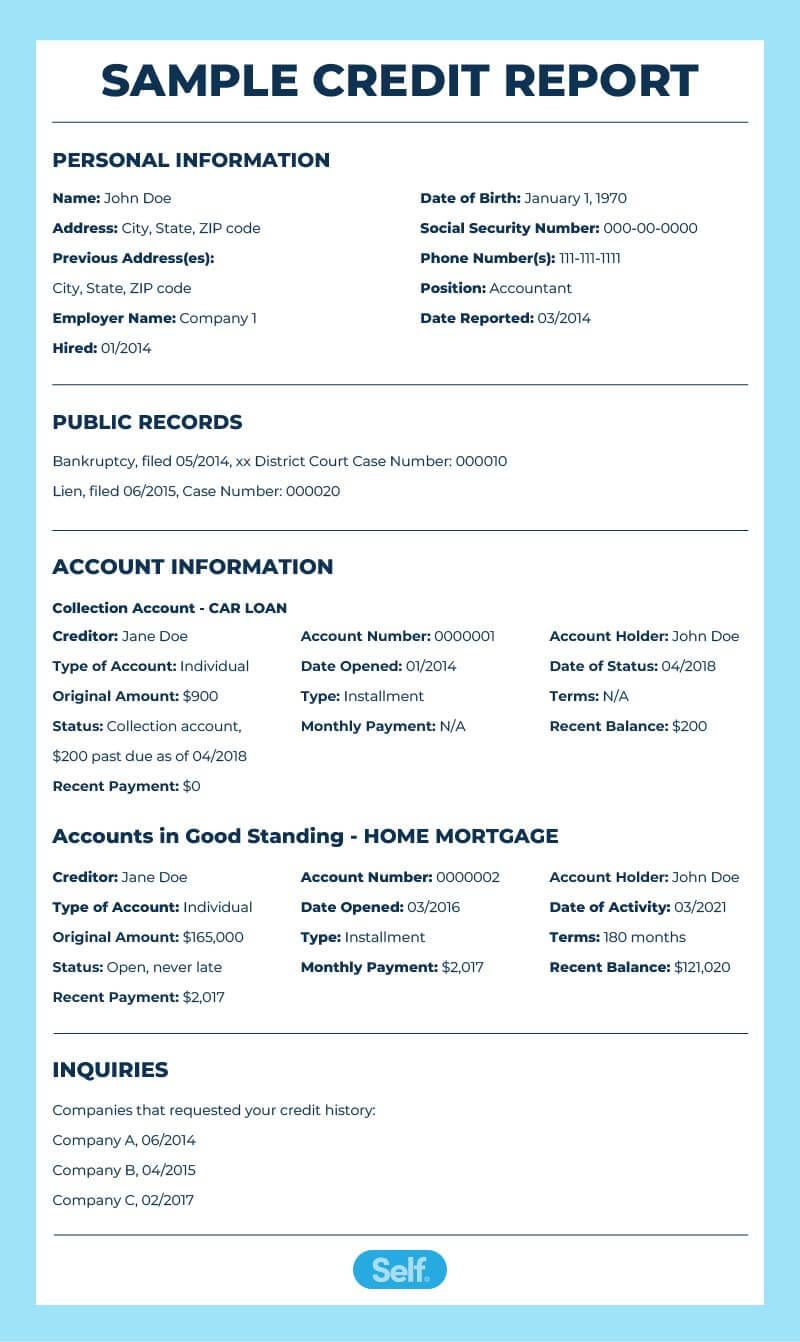
Once you have it open, your report breaks into four chunks. Read them in this order.
1. Your personal information. Name, current and past addresses, employers, date of birth. This looks boring, so everyone skips it. Do not skip it. A wrong address or a name you do not recognize can be the first sign of identity theft, or a sign your file got mixed up with someone who shares your name. If something here is wrong, that alone is worth a dispute.
2. Your accounts (the big one). This is also called your tradelines, and it is where the real story lives. Every credit card, car loan, mortgage, and student loan shows up here. For each account you want to check four things: the balance, the credit limit, the account status (open, closed, paid), and the payment history. That payment history is usually a row of little boxes or codes, one per month. A clean row is what you want. A box marked 30, 60, 90, or 120 means a late payment of that many days. Those late marks are what drag a score down hardest, so read every row.
3. Public records and collections. Bankruptcies live here. So do accounts that got handed off to a collection agency. Collections are heavy hitters, and they are also where a lot of errors hide, so give this section a slow read.
4. Inquiries. Every time someone pulls your credit, it gets logged. There are two kinds. A hard inquiry happens when you apply for something and can ding your score a little. A soft inquiry, like checking your own report, does not affect anything. If you see a hard inquiry from a company you never applied to, flag it.
What you are hunting for
Reading the report is not the goal. Finding what is wrong is the goal. As you go, you are looking for anything that is flatly inaccurate, because inaccurate items can be disputed and removed. Watch for accounts that are not yours, balances that are wrong, an account reported as late when you paid on time, the same debt listed twice, or a closed account still showing as open. Errors are far more common than people expect, and every one of them is a fixable point.
A word on medical debt, because the rules just changed
If you have medical collections on your report, read this part twice, because a lot of advice floating around online is now out of date.
In July 2025, a federal court struck down the rule that would have banned medical debt from credit reports. So the headlines you may have seen saying medical debt is gone? Not true anymore. Unpaid medical debt of $500 or more can still legally appear on your report.
That said, the credit bureaus made some of their own changes years ago that are still in place. Paid medical collections get removed no matter the amount, and unpaid medical collections under $500 get removed too. There is also a grace period of about twelve months before unpaid medical debt shows up at all. So if you spot a medical collection on your report that you already paid, or one under $500, or one that popped up the month after your visit, that should not be there. Dispute it.
A handful of states have also passed their own stronger laws on medical debt reporting, so it is worth knowing what your state allows.
Reading it is step one. Fixing it is step two.
Here is my honest opinion after doing this for a living. Most people can learn to read their report in an afternoon. What wears them down is the next part: the disputes, the follow ups, the letters, the waiting, and doing it across three bureaus at once while life keeps happening.
That is the part we handle. At Keys Credit, reading reports and challenging the errors on them is the whole job. So if you have read yours, circled five things that look wrong, and feel your eyes glazing over at the thought of fighting them one by one, that is exactly when to reach out.
Pull your report this week. Read all four sections. Mark what looks wrong. Then let's talk about cleaning it up. Call or text me at (623) 887-4572, email[email protected], or send a DM onInstagram@keys.credit.
Keylani OrtizREALTOR® | Keys Real Estate Services Serving Buckeye, Goodyear, Surprise, and the entire West Valley Hablamos español